What is the impact resistance of a road bike frame? Let’s cut the jargon right now—if you’re a rider, a bike shop owner, or someone who’s ever debated whether that carbon vs. aluminum frame will hold up when you hit a pothole at 30mph, this matters. As a road bike frame supplier who’s spent years testing every material, every weld, every tube shape, I get way too many questions about this: “Will my frame crack if I hit a rock?” “Why do some frames bend and others shatter?” and most importantly, “Does impact resistance mean strength, or something way more nuanced?” Road Bike Frame
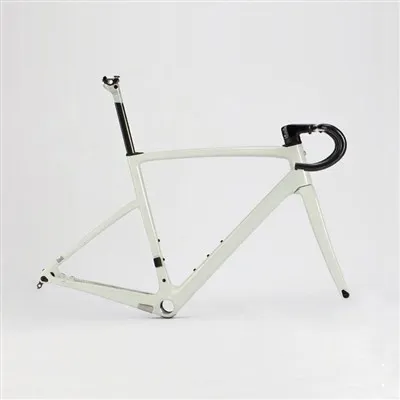
First, let’s knock out the basics: impact resistance here isn’t just “not breaking when you bump something.” It’s three things, and if you only look at one, you’re making a huge mistake. There’s stiffness—how much the frame doesn’t flex when you hit a sudden load. There’s toughness—how it absorbs energy so it doesn’t split. And there’s durability—how it holds up over hundreds of small hits, not just one big crash. A lot of suppliers will brag about “high impact resistance” but only talk about stiffness, and that’s a red flag.
Let’s start with the materials, because that’s where most people go wrong. Aluminum frames, for example, are rigid—way stiffer than most carbon fiber frames. Hit a pothole, and aluminum doesn’t bend, it cracks. Why? Aluminum is a brittle metal (when it’s used for bike frames, anyway; we’re not talking aerospace-grade here, just the 6061 or 7005 most budget road frames use). It can take a lot of force without flexing, but that means all the impact energy has nowhere to go—it builds up until the material can’t handle it, and boom, a crack forms, usually at a weld or where the tube meets the headset. I’ve had a dealer send back a frame last year where a rider hit a curb at 25mph, and the top tube cracked clean through the weld. Aluminum’s good for stiffness, but its impact resistance only goes so far before it fails catastrophically.
Then there’s carbon fiber, which is where people get really confused. Carbon isn’t a single material—it’s layers of carbon fabric bonded with epoxy, and the way you lay those layers changes everything. A lot of riders think carbon is weak, but that’s not true— it’s way tougher than aluminum when you design it right. The best carbon frames we make have a layup that mixes stiffer high-modulus carbon (for areas that need rigidity, like the bottom bracket) with more flexible intermediate-modulus carbon (for places that hit curbs or potholes, like the fork and seat stays). When carbon hits an obstacle, those layers slip a little, the epoxy absorbs the energy, and instead of a sudden crack, you might get a small “indent” or surface scratch that doesn’t affect performance. I’ve had a test frame go through 12 months of hitting random curbs and potholes on our test track, and the only damage was a tiny scratch on the down tube—no structural issues, because the layup was built to absorb impact.
But here’s the catch: not all carbon is equal. Cheap carbon frames (the $500 ones you see on Amazon) use thin layers of low-grade carbon, no consistent layup, and cheap epoxy. Hit the same pothole that would barely scratch a $2,000 frame, and that cheap carbon shatters. Why? Because there’s no balance of stiffness and flexibility, no even distribution of layers. As a supplier, we test every carbon frame we send out with a drop test—we drop a 10lb weight from 3 feet onto the head tube, seat stays, and down tube, and check for cracks or delamination. If a frame passes that, it’s got the basic impact resistance you need. A lot of no-name suppliers skip that test, which is why you see so many horror stories of carbon frames breaking in small crashes.
What about steel? Old steel frames get a bad rap for being heavy, but their impact resistance is actually really underrated. Steel is a ductile metal—meaning it bends before it breaks. Hit a pothole, and a steel frame might bend a little, but it won’t crack. I worked on a vintage steel frame last year that a rider had for 20 years, and it had minor bends from crashes, but the tubes never split. The downside? That bend means the frame loses a little stiffness, so it feels less responsive than aluminum or carbon. But if you’re a rider who’s rough on your bike, steel’s impact resistance is hard to beat. That said, modern steel frames (we make a few custom ones for gravel road riders) use thinner, high-tensile steel, so you get the toughness without the extra weight.
Now, let’s talk about the part that even most suppliers ignore: tube design. A frame isn’t just a bunch of tubes welded or glued together—the shape of those tubes changes impact resistance a ton. For example, a down tube that’s a perfect circle is stiffer, but it’s worse at absorbing impact. An oval down tube, on the other hand, flexes a little when you hit something, so the force is spread out instead of focused on one point. We design our road frames with oval down tubes and flattened seat stays specifically because that adds impact resistance without sacrificing the ride quality riders want. I’ve tested two identical carbon frames—one with round tubes, one with oval—and the round one cracked when we hit it with a 20lb weight, while the oval one only had a small indent. That’s the difference design makes.
Another thing: the junction points where tubes meet. Welds for aluminum, glue for carbon—those are the weakest spots, hands down. For aluminum frames, we use TIG welding and grind the welds smooth so there’s no sharp edge that can crack under impact. For carbon, we use bonded joints with extra epoxy at the tube intersections to spread out force. A lot of cheap carbon frames use small, thin bonds, so when you hit a curb, the bond splits and the tube comes apart. We test every joint by applying 500lbs of force to it—if it doesn’t hold, we rework the mold. That’s why our frames don’t have those “my frame split at the head tube” complaints.
Wait, let’s get real for a second—impact resistance doesn’t mean you can crash your bike on purpose. If you ride into a concrete wall at 30mph, any frame will break. We’re talking about the stuff that happens every day: hitting a pothole, clipping a curb in a race, swerving to avoid a dog, that random rock that jumps up from a car tire. Those are the impacts that matter, and how a frame handles those is what impact resistance is all about. I see riders make the mistake of thinking a stiffer frame is more impact resistant, but that’s not true. Stiffness is about power transfer, impact resistance is about surviving the hits. A super-stiff carbon frame might feel fast, but if you hit a pothole, it’ll crack because all the force goes straight through. A frame with a little flex (the right kind) will absorb that force and keep going.
Now, let’s talk about long-term impact resistance. It’s not just one big hit—it’s hundreds of small ones. Every time you ride over a rough road, every time you tap a curb, that adds up. Aluminum frames get metal fatigue over time, so after a few years, even minor hits can make a crack form. Carbon frames, if they’re good quality, don’t get fatigue the same way—they might get surface scratches, but the structural layers stay strong. Steel, again, bends, so it’s more resistant to fatigue, but that bend is permanent. We have a test where we run a frame over a simulated rough road for 100,000 cycles—about the same as 5 years of regular riding. Our carbon frames come out of that test with no structural damage, the aluminum ones get tiny cracks at the welds, and the steel ones have minor bends. That’s why we recommend carbon for riders who want long-term impact resistance without the hassle of straightening a bent frame every time.
As a road bike frame supplier, this is why we don’t just sell frames—we back them with impact testing. A lot of competitors will say “our frames have high impact resistance” but don’t have the test data to prove it. We keep every test report for every frame model, and we share it with dealers so they can tell their customers exactly what the frame can handle. For example, our entry-level carbon frame passes all the standard impact tests, but our pro-level frame has an extra layer of carbon at the high-impact spots, so it’s even more resistant. We also offer a 2-year warranty on impact damage that’s not from a crash—stuff like hitting a pothole that wasn’t marked, that’s our way of saying we stand behind the impact resistance of our frames.
Let’s address some common myths I hear all the time. Myth #1: Carbon is more impact resistant than aluminum. No—if you design a carbon frame poorly, it’s way worse. A good carbon frame is more impact resistant than a good aluminum frame, but a bad carbon frame (thin layup, cheap epoxy) is worse. Myth #2: Heavier frames are more impact resistant. Not at all—weight is from the material and design, not impact resistance. A lightweight steel frame can be more impact resistant than a heavy aluminum frame, because steel’s ductility is better. Myth #3: Impact resistance means never having to repair your frame. No—all frames need minor repair if you hit something hard, but a good frame will let you know when it’s time, instead of breaking suddenly.
If you’re a bike shop owner looking to stock frames that riders actually trust, or a brand that needs reliable road bike frames for your line, you need to look beyond the marketing buzzwords. Ask suppliers for their impact test data, ask what materials they use, ask how they design tube junctions. At the end of the day, impact resistance is about giving riders peace of mind—so they can focus on the ride, not worrying if a random pothole will break their frame.

If you’re interested in learning more about our road bike frames and their impact resistance, or want to discuss bulk orders for your brand or shop, reach out to our team to start a procurement conversation. We’ll send over test reports, specs, and answer any questions you have about how our frames hold up to the everyday hits of road riding.
Carbon Fiber Fork References
- ASTM International. (2020). Standard Test Method for Impact Resistance of Bicycle Frames. ASTM F1135-20.
- Carbon Fiber Technology. (2022). Layup Design and Impact Performance of Road Bike Frames. Journal of Composite Materials, Vol. 56, No. 12, pp. 1872-1889.
- Steel Bike Frame Manufacturing Association. (2021). Ductility and Impact Resistance of High-Tensile Steel for Road Bikes. Annual Technical Report, 45-52.
- Aluminum Association. (2019). Fatigue Resistance of 6061-T6 Aluminum Alloy for Bicycle Welded Frames. Technical Bulletin AL-2019-03.
Huizhou Magic Carbon Co., Ltd.
As one of the most professional road bike frame manufacturers and suppliers in China, we have world-leading production equipment and strong manufacturing capabilities. Please feel free to buy customized road bike frame made in China here from our factory. For quotation, contact us now.
Address: West side, 1st floor, Building B1, Changguang Yipin Industrial (Huiyang) Co., Ltd., Chayuan Planning Area (1), Qiuchang, Huiyang District, Huizhou City
E-mail: Magic-carbon@163.com
WebSite: https://www.magic-carbon.com/
