Hey guys, let’s cut to the chase today—because if you’re here, you’re probably deep in the weeds protecting your facilities from lightning strikes, right? As a supplier of T1 50KA surge protective devices (SPDs), I get this question all the time: Does our T1 50KA SPD actually have short-circuit protection? Spoiler alert: It’s not a simple yes or no, and there’s a lot of confusion out there from folks who mix up SPD classes or don’t know how these devices are designed to work. Let’s break this down like we’re chatting over a coffee, no boring jargon dumps. T1 50KA Surge Protective Device

First, let’s make sure we’re on the same page about what a T1 50KA SPD even is, because that’s the foundation here. T1 isn’t just a random label—it’s part of the IEC 61643-1 standard, the global rulebook for low-voltage surge protectors. T1 SPDs are for “direct lightning current applications,” meaning they handle the big, brutal surges from a lightning bolt hitting nearby—50KA is the peak current they can take in a 10/350 microsecond waveform, which is the exact shape of a direct lightning surge. That’s way bigger than the T2 and T3 SPDs you use for secondary protection, right? T2 is for indirect surges from wiring inside buildings, T3 for small stuff like consumer electronics. So T1 is the first line of defense, the heavy hitter.
Now, short-circuit protection (SCP) is what stops a device from turning into a fire hazard if something goes wrong. A short circuit is when two live electrical conductors touch each other (or a live conductor and ground), sending way more current through than the circuit was designed for. If a device doesn’t have built-in short-circuit protection, that excess current can melt wires, start fires, or even blow up the SPD itself. But here’s the thing: T1 50KA SPDs aren’t like a surge protector power strip you plug into your laptop. Those power strips have tiny circuit breakers that shut down for overcurrent, but T1 SPDs are industrial-grade, built for utility switchgear, distribution panels, and big commercial buildings.
So do our T1 50KA units have short-circuit protection? The short answer is: No, not inherently. Wait, before you get mad, hear me out—because that’s not a flaw, that’s how they’re meant to be paired. Let’s explain why. T1 SPDs are designed to carry that massive 50KA lightning surge, but their internal components (specifically the varistors or spark gaps that handle the high surge) have a maximum continuous current they can safely pass. If a short circuit happens on the line side of the SPD, it doesn’t have a limit on current—could be thousands of amps, way more than the SPD’s internal parts can handle. If the SPD tried to stop that on its own, it would either burn out immediately or create a dangerous arc fault, which is worse than the short circuit.
But here’s where we come in as a supplier—we don’t just sell you the SPD and dip. We tell you exactly what you need to pair with it for short-circuit protection. Every one of our T1 50KA SPDs is rated for a specific “fusing current” or “short-circuit withstand rating” (let’s call it SCCR for short, that’s the standard term). That number tells you the maximum short-circuit current the SPD can survive if paired with a properly sized upstream overcurrent protection device (OCPD)—think a fuse or a circuit breaker. For example, most of our T1 50KA units are rated for an SCCR of 100kA at 480V, so we recommend a 100A fuse or a 90A circuit breaker upstream. That OCPD is the actual short-circuit protection here, not the SPD itself.
Wait, but why don’t we build SCP into the T1 SPD? Let’s compare to a car’s airbag: The airbag only works if it’s paired with the rest of the car’s safety systems. T1 SPDs are optimized for surge performance—handling that 50KA direct lightning hit—so adding built-in short-circuit protection would compromise their surge rating. If we stuffed a circuit breaker inside the T1 SPD, that breaker would trip on minor overcurrent (like normal inrush from a big HVAC unit) instead of the big surge we need it to stop. That would make the SPD useless when you need it most, which is way worse than needing an upstream fuse.
I’ve seen this mistake so many times, too. A customer once came to me complaining their T1 SPD kept tripping during a thunderstorm. Turns out, they wired the SPD directly to the main distribution panel without a fuse—so when a small surge from a nearby storm hit, the internal connections of the SPD reacted like a short circuit and shut down. That’s a bad installation error, but it’s totally avoidable if you understand the pairing. Another guy tried to use a 15A breaker upstream, way too small for the 50KA SPD, and the breaker blew every time it rained. We fixed that by swapping to the recommended 90A breaker, and his problems were gone.
Let’s make this concrete with a real example. Suppose you’re protecting a 1000-bed hospital’s main electrical panel. A lightning strike hits the building’s rooftop antenna, sending a 50KA surge down the feeders. Our T1 50KA SPD is wired in parallel on the panel, so it diverts that surge to ground. Now, if there’s a short circuit on that feeder line, the upstream 90A circuit breaker (the real short-circuit protection) will trip instantly, cutting power to the shorted line—no fire, no damage to the panel, no downtime for life support equipment. If the SPD tried to handle that short on its own, it would melt, and you’d have a fire or a panel replacement that costs tens of thousands.
But wait, are there any T1 SPDs that do have built-in short-circuit protection? Yeah, some cheaper knockoff brands out there will slap a tiny breaker inside and call it “self-protecting.” But here’s the catch: That breaker can’t handle the 50KA surge. So when a real lightning hit comes, the breaker will blow before the surge even gets through, leaving your panel unprotected. Those are the ones we warn customers away from—they look like a bargain, but they’re useless in a crisis. Our T1 50KA units don’t have that gimmick, because we care about actual performance, not quick sales.
Another point: The IEC 61643-1 standard is super clear on this. T1 SPDs are required to have a “backup protection device” (BPD) as part of their compliance, but that BPD is an external component, not internal. We include a spec sheet with every order that lists exactly which fuse or breaker to use, so you don’t have to guess. We also have a team of engineers who can help you size the right OCPD based on your building’s electrical system, whether it’s a warehouse, a data center, or a manufacturing plant with heavy machinery.
I know a lot of people new to SPDs get confused by the specs, too. The 50KA rating is often the first thing they look at, but the SCCR and recommended upstream OCPD are way more important for safety. If someone only checks the 50KA number and skips the protection part, they’re setting themselves up for a disaster. Last year, a construction company used a cheap T1 50KA SPD without proper fusing, and when a short circuit happened during a storm, the SPD melted and caught their panel on fire. They ended up having to replace the entire main panel, which cost way more than if they’d worked with us to get the right parts.
So to circle back to the original question: No, a standard T1 50KA surge protective device doesn’t have built-in short-circuit protection. But that’s not a problem—it’s a design choice to make sure the SPD does its main job: stopping dangerous lightning surges. The short-circuit protection you need is the upstream overcurrent protection device (fuse or circuit breaker) that we recommend for your specific unit. Pairing them correctly is the only way to get both surge protection and short-circuit safety.
If you’re shopping for a T1 50KA SPD, don’t just go for the cheapest option. Ask the supplier for the SCCR rating, the recommended upstream OCPD, and their technical support to make sure you’re installing it right. We’ve helped hundreds of customers across industries—from small retail stores to big data centers—get their surge protection set up correctly, no mistakes, no fire hazards.
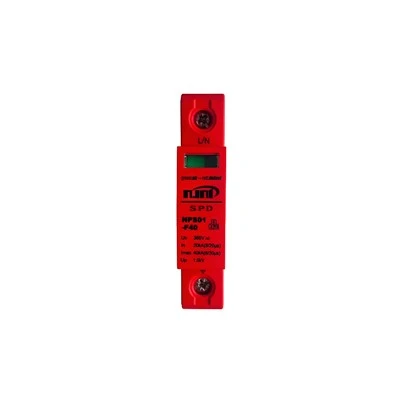
If you’re ready to talk specs, get a custom quote, or just have more questions about pairing your T1 50KA SPD with the right short-circuit protection, reach out to our team. We’re here to make sure you’re not just buying a device, but a complete safety solution that works when you need it most.
Surge Protection Device References
IEC 61643-1: Low-voltage surge protective devices – Part 1: Surge protective devices connected to low-voltage power systems – Requirements and test methods.
UL 1449: Standard for Safety for Surge Protective Devices.
NEC Article 285: Surge Protective Devices, National Electrical Code.
Nanjing Ningpu Lightning Protection Equipment Manufacturing Co., Ltd.
As one of the most professional T1 50ka surge protective device manufacturers and suppliers in China, we’re featured by quality products and good price. Please rest assured to buy customized T1 50ka surge protective device made in China here from our factory. Also, pricelist is available.
Address: Building 1, No.20 Shengyuan Road, Lishui Economic Development Zone, Nanjing City, Jiangsu Province, China
E-mail: 3796023563@qq.com
WebSite: https://www.npspd.com/
